Funny that my ears are actually getting accustomed to listening to Babbitt’s music, or other avant-garde compositions for that matter. Why am I surprised? This is simply the result of a small attempt to immerse myself into the world of previously unfamiliar 20thC music for the last 3 months.
Out of all the different domains and aspects of 20thC music we’ve covered, Minimalism still appeals to me the most. (This has always been the case actually.) Somehow I can identify with it without much difficulty and it captures my attention. Don’t know how else to put it. argh. Really wonder if it’s the same for others or is it just my ears? Is it true for most people that in general, Minimalism is more accessible (aurally) than other forms of 20thC music?
Looking back, I’ve realized that I’ve come quite a long way in a short 3-month time frame. Reason being that previously I found 20thC pieces completely unintelligible. Also, I’m ashamed to admit that I was even mocking at such form of “music” and questioning the musical ability of their respective “composers”. (absolutely rude and obnoxious of me.) :-S This was because I was still listening to them through my tonal and biased ears! I just simply need to put on another fresh pair of listening ears.
I must say that I have been humbled by my newfound respect for the 20thC composers. (Well, it’s ‘newfound’ from my perspective – they have always been great and respectable.) Another reason is that I tried my hand at writing a piece of music in the 20thC style (quite vague, I know). And it’s really really difficult/tedious (but rewarding) despite it only being a short 1.5min piece with superficial features. Imagine the massive amount of mind-boggling compositional decisions that Babbitt had to grapple with. Respect.
So, yep.. I’m sure Babbitt would be pleased with my learning-journey. :-)
“.. in lowliness of mind let each esteem others better than himself.”


31 October 2008
Notes on Babbitt's Electronic Music
Just jotting some notes on electronic music..
Interview with Babbitt (1968)
Babbitt says that there are three ways to produce electronic music:
- the tape studio
- the synthesizer
- the computer
finding this article is very timely and i'm very thankful for it! :) especially this is directly from Babbitt describing his works.
i was just getting so confused over one other reading which makes the distinction between ‘computer music’ and ‘tape music’ in the domain of ‘electronic music’. however it does not explain it clearly. most other readings also do not make the distinction even though it is significant.
Other interesting quotations/points raised in this article but not directly relevant to this research:
- pitch is the most impt aspect of musical structure? hmm..
Babbitt says, "As a composer, I still feel that pitch is the single most important aspect of musical structure."
- Babbitt's opinion of electronic music in music education, back in 1968.
"Fowler. In your opinion, what would an eighth- or ninth-grade music teacher have to know in order to introduce electronic music to his students in an interesting way?
Babbitt. The significant issue here is how to develop a child's musicality from every conceivable point of view. The question of the particular medium would just be a question of being able to inform the child in a rudimentary way. I would think that the music educator who is competent to make decisions about a child's musical training could easily acquire the slight amount of information that would be necessary. There's no music educator who couldn't learn to do that in a very, very short time. The information is available. In fact, this issue of the Journal should provide enough such information. There's no reason in the world why the music educator should have to be a technological expert. Very few composers are. I don't have to know how to build an oboe to write for it, and I don't have to know how to build a synthesizer to write for it. The educator doesn't need this technological information either. The educator simply has to be able to describe in very general but accurate terms how these media operate, just enough to arouse the child's interest and avoid misunderstanding."
"It is entirely up to the music educator to decide the complexity of the music appropriate to the development of a child. Whether it be electronic or not, I would insist, is irrelevant."
These are excerpts taken from:
An Interview with Milton Babbitt (1968) from the Music Educators Journal, Vol. 55, No. 3
Interview with Babbitt (1968)
Babbitt says that there are three ways to produce electronic music:
- the tape studio
- the synthesizer
- the computer
finding this article is very timely and i'm very thankful for it! :) especially this is directly from Babbitt describing his works.
i was just getting so confused over one other reading which makes the distinction between ‘computer music’ and ‘tape music’ in the domain of ‘electronic music’. however it does not explain it clearly. most other readings also do not make the distinction even though it is significant.
Other interesting quotations/points raised in this article but not directly relevant to this research:
- pitch is the most impt aspect of musical structure? hmm..
Babbitt says, "As a composer, I still feel that pitch is the single most important aspect of musical structure."
- Babbitt's opinion of electronic music in music education, back in 1968.
"Fowler. In your opinion, what would an eighth- or ninth-grade music teacher have to know in order to introduce electronic music to his students in an interesting way?
Babbitt. The significant issue here is how to develop a child's musicality from every conceivable point of view. The question of the particular medium would just be a question of being able to inform the child in a rudimentary way. I would think that the music educator who is competent to make decisions about a child's musical training could easily acquire the slight amount of information that would be necessary. There's no music educator who couldn't learn to do that in a very, very short time. The information is available. In fact, this issue of the Journal should provide enough such information. There's no reason in the world why the music educator should have to be a technological expert. Very few composers are. I don't have to know how to build an oboe to write for it, and I don't have to know how to build a synthesizer to write for it. The educator doesn't need this technological information either. The educator simply has to be able to describe in very general but accurate terms how these media operate, just enough to arouse the child's interest and avoid misunderstanding."
"It is entirely up to the music educator to decide the complexity of the music appropriate to the development of a child. Whether it be electronic or not, I would insist, is irrelevant."
These are excerpts taken from:
An Interview with Milton Babbitt (1968) from the Music Educators Journal, Vol. 55, No. 3
25 October 2008
Structure/Outline of Research on Babbitt
Core focus:
- An introduction to Babbitt and his music
- How to approach Babbitt’s music
History of Babbitt
- Most known for his works in Serialism and Electronic music
- Very strong background in mathematics (has an impact on how he conceives music)
- Influenced by Schoenberg and Webern. He first encountered their works when he was studying in New York University and carried on to develop his 12-tone technique.
- He was part of the faculty at Princeton which was at the forefront of electronic music (Griffiths, 1981). This complemented Babbitt in his musical pursuit.
Serialism
- Babbitt’s development of Serialism (different from other serial composers – both his predecessors and contemporaries)
- Pieces to focus on:
Semi-Simple Variations (1956)
Minute Waltz (1977)
- Analysis by Morgan (1992), Wintle (1976), Blaustein and Brody (1986)
- Other interesting ideas identified such as its surface features
Electronic Music
- Babbitt’s purpose of exploring this medium is to achieve precision which is not possible with humans
- There is a need for the electronic medium
Examples of Relata I (1965) and Post-Partitions (1966)
- A piece to focus on:
Composition for Synthesizer (1961)
- Analysis by Morris (1997)
Listening to Babbitt
- Straus’ (1986) opinion on listening to Babbitt’s music is by appreciating the surface features: (a) contours; (b) dynamics; (c) register.
Example of String Quartet No. 2 (1954)
- However, I do have some reservations about Straus’ article.
(i) He focuses all his attention on surface features and relationships and does not agree with an in-depth exploration of Babbitt’s works. I disagree because Babbitt’s music is so much more meaningful and valuable below its surface.
(ii) Using String Quartet No. 2 as a sole example in this article is not a fair representation of all of Babbitt’s works, especially when Straus uses this to prove his point that ‘Babbitt’s music should be appreciated by listening to surface features’. This piece of music is one of Babbitt's simplest in terms of prominence of surface features.
- There is a need to understand the structure and underlying compositional strategies in order to fully appreciate Babbitt’s music.
- An introduction to Babbitt and his music
- How to approach Babbitt’s music
History of Babbitt
- Most known for his works in Serialism and Electronic music
- Very strong background in mathematics (has an impact on how he conceives music)
- Influenced by Schoenberg and Webern. He first encountered their works when he was studying in New York University and carried on to develop his 12-tone technique.
- He was part of the faculty at Princeton which was at the forefront of electronic music (Griffiths, 1981). This complemented Babbitt in his musical pursuit.
Serialism
- Babbitt’s development of Serialism (different from other serial composers – both his predecessors and contemporaries)
- Pieces to focus on:
Semi-Simple Variations (1956)
Minute Waltz (1977)
- Analysis by Morgan (1992), Wintle (1976), Blaustein and Brody (1986)
- Other interesting ideas identified such as its surface features
Electronic Music
- Babbitt’s purpose of exploring this medium is to achieve precision which is not possible with humans
- There is a need for the electronic medium
Examples of Relata I (1965) and Post-Partitions (1966)
- A piece to focus on:
Composition for Synthesizer (1961)
- Analysis by Morris (1997)
Listening to Babbitt
- Straus’ (1986) opinion on listening to Babbitt’s music is by appreciating the surface features: (a) contours; (b) dynamics; (c) register.
Example of String Quartet No. 2 (1954)
- However, I do have some reservations about Straus’ article.
(i) He focuses all his attention on surface features and relationships and does not agree with an in-depth exploration of Babbitt’s works. I disagree because Babbitt’s music is so much more meaningful and valuable below its surface.
(ii) Using String Quartet No. 2 as a sole example in this article is not a fair representation of all of Babbitt’s works, especially when Straus uses this to prove his point that ‘Babbitt’s music should be appreciated by listening to surface features’. This piece of music is one of Babbitt's simplest in terms of prominence of surface features.
- There is a need to understand the structure and underlying compositional strategies in order to fully appreciate Babbitt’s music.
24 October 2008
Reply to Jean - programmatic titles?
Hello Jeanette, :)
My response to your comment is quite long so I’ll post it here instead of the small box in the Comments page. Thanks for dropping by!
(Programmatic title – Titles which evoke a scene/image/mood in the mind.)
A few of Babbitt’s music does indeed have programmatic titles, while most have neutral sounding ones which simply describes the form or compositional technique used. Let me give you a few examples:
Programmatic titles:
An Elizabethan Sextette - 1'When I Was Fair And Young' (1979)
An Elizabethan Sextette - 3'Your Face, Your Tongue, Your Wit' (1979)
Lagniappe (1985) (meaning: a small present/gift)
The Widow’s Lament in Springtime (1950)
‘Neutral-sounding’ titles:
Duet (1956)
Partitions (1957)
Preludes, Interludes, And Postlude (1991)
Three Compositions (1947)
Just to add on if you were wondering if the music itself is programmatic, my answer would be ‘no’. This is quite tricky. Take Minute Waltz for example – analysts discovered that Babbitt exploits all possible types of ‘oom-pah’ patterns in this “waltz”. Hence by right the listener should be able to have the waltz feel and perhaps imagine a ballroom where people are waltzing. However when I listen to this piece of music, it does not even remotely resemble a conventional waltz like we know it to be. This – as I understand – is due to the nature of Serial music. Therefore Babbitt’s music is not programmatic even though the descriptions used might seem like it.
My response to your comment is quite long so I’ll post it here instead of the small box in the Comments page. Thanks for dropping by!
(Programmatic title – Titles which evoke a scene/image/mood in the mind.)
A few of Babbitt’s music does indeed have programmatic titles, while most have neutral sounding ones which simply describes the form or compositional technique used. Let me give you a few examples:
Programmatic titles:
An Elizabethan Sextette - 1'When I Was Fair And Young' (1979)
An Elizabethan Sextette - 3'Your Face, Your Tongue, Your Wit' (1979)
Lagniappe (1985) (meaning: a small present/gift)
The Widow’s Lament in Springtime (1950)
‘Neutral-sounding’ titles:
Duet (1956)
Partitions (1957)
Preludes, Interludes, And Postlude (1991)
Three Compositions (1947)
Just to add on if you were wondering if the music itself is programmatic, my answer would be ‘no’. This is quite tricky. Take Minute Waltz for example – analysts discovered that Babbitt exploits all possible types of ‘oom-pah’ patterns in this “waltz”. Hence by right the listener should be able to have the waltz feel and perhaps imagine a ballroom where people are waltzing. However when I listen to this piece of music, it does not even remotely resemble a conventional waltz like we know it to be. This – as I understand – is due to the nature of Serial music. Therefore Babbitt’s music is not programmatic even though the descriptions used might seem like it.
10 October 2008
"Listening to Babbitt" by J. Straus
Just browsed through the first few pages of Straus' article on Listening to Babbitt. :) It seems great. What a refreshing perspective - he takes a listener-oriented approach. This is as opposed to the few other articles I’ve seen that gives micro-detailed analyses of how musical notes are structured in a piece. I'm sure this reading would be useful and would yield interesting insights.
Careless of me to have put aside this article all these while and instead pore over complicated impossible-to-comprehend analyses of Babbitt's music. **Perhaps my focus should be more on what I 'hear' instead of all the detailed analyses which I feel are slightly beyond me. Then again, not sure if I'm doing justice to Babbitt if I take this superficial approach..
Careless of me to have put aside this article all these while and instead pore over complicated impossible-to-comprehend analyses of Babbitt's music. **Perhaps my focus should be more on what I 'hear' instead of all the detailed analyses which I feel are slightly beyond me. Then again, not sure if I'm doing justice to Babbitt if I take this superficial approach..
02 October 2008
Learning to appreciate Babbitt's music (or 20thC music as well)
I’ve been wondering..
All those pieces of 20thC music we’ve explored so far (eg. Babbitt, Berg, Ravel, Messiaen, Schoenberg, etc.), they seem to be crafted in such an intellectual and mathematical way and it is really quite exciting when we discover these compositional strategies. Does it mean that the way we appreciate these pieces of music should also be from an intellectual perspective as well? The reason why I say this is also because these pieces of music are not those that our ears are accustomed to listening or the conventional sit-back-relax-and-enjoy type (like FM92.4 would say it).
Referring specifically to Babbitt’s music, Andrew Mead (1994) says that we must be able to follow the music’s structure in order to fully appreciate it. This is because “the strong emotional and expressive charge of his music is deeply rooted in the ways notes and rhythms work together to create webs of association and connection over ever-larger spans of time.” I was quite pleasantly surprised that Mead or anyone else would describe these music with phrases like ‘strongly emotional’ and ‘sensuous beauty’. Previously, I only thought that music by Chopin, Liszt or their contemporaries could be described as such, but not anymore. This new perspective opened up for me another set of ears when listening to 20thC music.
All those pieces of 20thC music we’ve explored so far (eg. Babbitt, Berg, Ravel, Messiaen, Schoenberg, etc.), they seem to be crafted in such an intellectual and mathematical way and it is really quite exciting when we discover these compositional strategies. Does it mean that the way we appreciate these pieces of music should also be from an intellectual perspective as well? The reason why I say this is also because these pieces of music are not those that our ears are accustomed to listening or the conventional sit-back-relax-and-enjoy type (like FM92.4 would say it).
Referring specifically to Babbitt’s music, Andrew Mead (1994) says that we must be able to follow the music’s structure in order to fully appreciate it. This is because “the strong emotional and expressive charge of his music is deeply rooted in the ways notes and rhythms work together to create webs of association and connection over ever-larger spans of time.” I was quite pleasantly surprised that Mead or anyone else would describe these music with phrases like ‘strongly emotional’ and ‘sensuous beauty’. Previously, I only thought that music by Chopin, Liszt or their contemporaries could be described as such, but not anymore. This new perspective opened up for me another set of ears when listening to 20thC music.
06 September 2008
The Glossary
Terms used in analysing Babbitt's Semi-Simple Variations:
Aggregate
Hexachord
A collection of 6 chromatic pitches. (Hence each twelve-tone set would contain two hexachords.)
Hexachordal Combinatoriality
This refers to a specific type of tone row that is obtained from the combination of a hexachord with a transposition of its inversion.
Derived Set
This refers to a very specific type of tone row. It requires a segment - trichord, tetrachord or hexachord - to be subjected to transposition, inversion or retrograde in order to derive the entire set of twelve tones.
Aggregate
Hexachord
A collection of 6 chromatic pitches. (Hence each twelve-tone set would contain two hexachords.)
Hexachordal Combinatoriality
This refers to a specific type of tone row that is obtained from the combination of a hexachord with a transposition of its inversion.
Derived Set
This refers to a very specific type of tone row. It requires a segment - trichord, tetrachord or hexachord - to be subjected to transposition, inversion or retrograde in order to derive the entire set of twelve tones.
03 September 2008
First posting on Milton Babbitt
Milton Babbitt (b. 1916) is an American composer most known for his twelve-tone theory and works as well as his electronic music. He is very well-read and knowledgeable in other disciplines other than music, especially in mathematics. He formalized many of the most important aspects of twelve-tone compositional techniques using terms from other areas of study. One of these terms is “set” in response to Schoenberg’s use of the term “row”, where the latter has certain biasness which suggests a certain idea progressing from the left to right. Speaking of Schoenberg, Babbitt’s work and musical thinking mostly stem from the Second Viennese School (ie. Schoenberg, Webern and Berg).
His view of the twelve-tone system is that it is different in kind, not simply in degree, from the tonal system: “The tonal motive assumes functional meaning within a context, and becomes, in turn, a vehicle of movement within this context; the twelve-tone set, however, is the instigator of movement, and defines the functional context.” Babbitt is by no means rigidly confined by the rules and regulations of the twelve-tone technique. Within these constraints, he uses a wide range of expressive possibilities and structures.
Babbitt is also very well-known for his article “Who Cares If You Listen?”, unfortunately. This title was given by journalists without his knowledge or permission. This is most unfortunate because Babbitt in his own words says that “I care a great deal who listened, but above all how they listened” (Gagne & Caras, 1982). He also gets very annoyed at other professionals who would become irritated when Babbitt insists that his music be taken seriously. Most of the other people simply feel that music should only provide them with entertainment or relaxation from their more important pursuits.
Reading Babbitt’s lectures and a transcript of an interview with him, it is clear that he is very passionate about what he does. So much so that it becomes infectious and compels me to take a closer look at his works. Personally I used to question if this kind of music is really music cos it really really doesn’t seem to make any cow sense! I want to make sense of it but it’s highly annoying that I’m not able to. My aim for the next few months or so would be to immerse myself in the world of Babbitt’s music, learn to make sense of it and know how to approach it. Hopefully in time to come my attitude towards Serial practice would progress like this:
know -> understand -> appreciate -> accept -> embrace! (heh)
Having found out more about Babbitt and the twelve-tone system, I find that it can be related to what we have learnt in class about Set Theory. They both free us from having tonal hierarchy in music. This is possible in Set Theory using 4 assumptions and they are:
- Octave equivalence
- Enharmonic equivalence
- Transpositional equivalence
- Inversional equivalence
What has been researched so far:
To date, many of Babbitt’s works have been analysed by theorists. A few major ones that I have come across include Three Compositions for Piano (1947), Composition for Twelve Instruments (1948,54), Semi-Simple Variations for Piano (1956) and Partitions for Piano (1957).
I’ll most probably start with Semi-Simple Variations for Piano. :)
His view of the twelve-tone system is that it is different in kind, not simply in degree, from the tonal system: “The tonal motive assumes functional meaning within a context, and becomes, in turn, a vehicle of movement within this context; the twelve-tone set, however, is the instigator of movement, and defines the functional context.” Babbitt is by no means rigidly confined by the rules and regulations of the twelve-tone technique. Within these constraints, he uses a wide range of expressive possibilities and structures.
Babbitt is also very well-known for his article “Who Cares If You Listen?”, unfortunately. This title was given by journalists without his knowledge or permission. This is most unfortunate because Babbitt in his own words says that “I care a great deal who listened, but above all how they listened” (Gagne & Caras, 1982). He also gets very annoyed at other professionals who would become irritated when Babbitt insists that his music be taken seriously. Most of the other people simply feel that music should only provide them with entertainment or relaxation from their more important pursuits.
Reading Babbitt’s lectures and a transcript of an interview with him, it is clear that he is very passionate about what he does. So much so that it becomes infectious and compels me to take a closer look at his works. Personally I used to question if this kind of music is really music cos it really really doesn’t seem to make any cow sense! I want to make sense of it but it’s highly annoying that I’m not able to. My aim for the next few months or so would be to immerse myself in the world of Babbitt’s music, learn to make sense of it and know how to approach it. Hopefully in time to come my attitude towards Serial practice would progress like this:
know -> understand -> appreciate -> accept -> embrace! (heh)
Having found out more about Babbitt and the twelve-tone system, I find that it can be related to what we have learnt in class about Set Theory. They both free us from having tonal hierarchy in music. This is possible in Set Theory using 4 assumptions and they are:
- Octave equivalence
- Enharmonic equivalence
- Transpositional equivalence
- Inversional equivalence
What has been researched so far:
To date, many of Babbitt’s works have been analysed by theorists. A few major ones that I have come across include Three Compositions for Piano (1947), Composition for Twelve Instruments (1948,54), Semi-Simple Variations for Piano (1956) and Partitions for Piano (1957).
I’ll most probably start with Semi-Simple Variations for Piano. :)
09 August 2008
Revival!
Hello. :) Happy National Day.
ahh. Time to revive my blog!! Last post was..
20 June 2007
Gasp.
Just a few months back I was doing an analysis of the theme song from Secret. It's the one starring and directed by Jay Chou. Yeah, a bit too common, I know.. everyone's playing it especially the secondary school kids.
The most interesting finding was that as the piece progresses, it moves through different eras as reflected in the characteristics and style of the music. This coincides with the scene that is showing the player going back in time as the piece is played. cool.
i'll post the details IF i have the spare time. heh.
For now, i'm into Milton Babbitt.
Babbitt = Bad Rabbit??
We'll find out soon. :)
ahh. Time to revive my blog!! Last post was..
20 June 2007
Gasp.
Just a few months back I was doing an analysis of the theme song from Secret. It's the one starring and directed by Jay Chou. Yeah, a bit too common, I know.. everyone's playing it especially the secondary school kids.
The most interesting finding was that as the piece progresses, it moves through different eras as reflected in the characteristics and style of the music. This coincides with the scene that is showing the player going back in time as the piece is played. cool.
i'll post the details IF i have the spare time. heh.
For now, i'm into Milton Babbitt.
Babbitt = Bad Rabbit??
We'll find out soon. :)
20 June 2007
Final Assessment Qn1
Final Assessment
Question 1: Consolidation and self-reflection of blog posts
My selected area of focus was Rock music, an area which I was completely alien to, and finally decided to narrow my scope and look only at music written by the Beatles as they were the ones who have impact Rock culture in the 1960s the most.
My most significant learning point was the identifying of mixture harmonies, and this came only at the very end of this assignment which was from the individualized assessment questions. Before that while doing the analysis of these three Lennon and McCartney songs, it did not occur to me that primary and modal mixtures were used and were not aware of them. Being able to identify them later on helped me have a better understanding of mixture harmonies especially in ‘Lady Madonna’ and ‘Lucy in the Sky with Diamonds’ where the primary mixture was used and also the modal mixture of Lydian mode as described further in Question 2.
Another insight was seeing how very simple melodies in those songs were treated that they can be used many times but yet does not get boring at all. An example is ‘Lucy in the Sky with Diamonds’ which has very simple and repeated melodic ideas but remain interest by having unconventional underlying harmonies. It also does not stick to one idea for a long period of time as we see that this song has three short sections with different ideas for each.
There is a question yet to be answered from the comments of the very last post on 31 March 2007 regarding the key of the introduction of ‘Eleanor Rigby’. I too also struggled to decide if the key should be in E minor or G major as both were possible options, but in the end I still decided that there was a stronger sense of E minor. A possible reason why Jeanette felt a stronger sense of E minor only in the verse as said in her comments could be because the verse uses an E minor pedal like a drone and briefly switching to C major and back again to E minor.
Question 1: Consolidation and self-reflection of blog posts
My selected area of focus was Rock music, an area which I was completely alien to, and finally decided to narrow my scope and look only at music written by the Beatles as they were the ones who have impact Rock culture in the 1960s the most.
My most significant learning point was the identifying of mixture harmonies, and this came only at the very end of this assignment which was from the individualized assessment questions. Before that while doing the analysis of these three Lennon and McCartney songs, it did not occur to me that primary and modal mixtures were used and were not aware of them. Being able to identify them later on helped me have a better understanding of mixture harmonies especially in ‘Lady Madonna’ and ‘Lucy in the Sky with Diamonds’ where the primary mixture was used and also the modal mixture of Lydian mode as described further in Question 2.
Another insight was seeing how very simple melodies in those songs were treated that they can be used many times but yet does not get boring at all. An example is ‘Lucy in the Sky with Diamonds’ which has very simple and repeated melodic ideas but remain interest by having unconventional underlying harmonies. It also does not stick to one idea for a long period of time as we see that this song has three short sections with different ideas for each.
There is a question yet to be answered from the comments of the very last post on 31 March 2007 regarding the key of the introduction of ‘Eleanor Rigby’. I too also struggled to decide if the key should be in E minor or G major as both were possible options, but in the end I still decided that there was a stronger sense of E minor. A possible reason why Jeanette felt a stronger sense of E minor only in the verse as said in her comments could be because the verse uses an E minor pedal like a drone and briefly switching to C major and back again to E minor.
Final Assessment Qn2
Final Assessment
Question 2: Three Lennon & McCartney songs
i. All three songs you have chosen betray a rather idiosyncratic use of mixture harmonies, whether in the major or minor keys. Examine and comment. Consider their renderings both in the melody and in the harmony.
[Special note: Obviously, answers to these two questions can be full-length essays, but for this test you need only discuss 2 or 3 instances in each case.]
Eleanor Rigby
The home key of this song is E minor and the use of the Dorian mode with its 6th raised, ie. C#, as a mixture harmony is also very distinct. This is seen in the chorus (b.19-26) and also in the verses. In the chorus, it seems to be switching between tonal and modal harmony especially because of the C# appearing.
Perhaps the Dorian traditional/church mode had been used here deliberately because the scenario of this song is also in a church.
Lady Madonna
Primary mixture harmony is used extensively in this entire song. It is the borrowing of diatonic chords from its parallel major/minor, which is A minor in this case. Examples are shown below in (2a) in b.15.

Looking at this song from the perspective of a mixture harmony, the song does not modulate to C major as said previously in my 31 March 2007 posting on ‘Lady Madonna’. Instead, it remains in A major and the chords used are borrowed from A minor as seen in (2b) from b.25 to 31.

As for the melody, the flattened third (C natural) occurs very frequently. This is also very common in blues. The sixth and seventh of the scale is also flattened occasionally but not as frequently. An example of the melody using the mixture harmony is also in (2a) above where the melody uses G natural and C natural.
It is interesting to note that at b.15 at (2a) even though C natural is used in the melody, that chord still contains a C#, resulting in a false relation. I believe this C# is used as a Common Tone which leads to the A major chord that follows.
Lucy in the Sky with Diamonds
There are two types of mixture harmonies used in this song – primary mixture and modal mixture.
The primary mixture occurs in the first part of the verses in the A major section, b.5 to 21. Similar to Lady Madonna, some chords are borrowed from its parallel minor of A minor. An example of those chords can be seen underlined in (3a).

The modal mixture occurs in the second part of the verses in Bb major, b.24 to 35. The Lydian mode is used where the 4th is raised, ie. E natural. One example can be seen in (3b), giving rise to a major chord II.

ii. Another prominent musical feature is the use of a scalic motif/idea as a recurrent or repetitive element in all three songs. This has a unifying effect on the one hand but it also betrays the composers’ ingenuity on the other. Again, identify the motif in each song to examine and comment.
The main idea found in all three songs is the use of descending partially-chromatic motifs. However, they are handled differently in each case.
Eleanor Rigby
The main motif of this song is A G F# E in b.2 labeled as (1a). It recurs many times throughout the song as seen in the score, labeled from (1b) to (1e). However, this does not make the song any less interesting because it always reappears in varying forms. Even though (1c), (1d) and (1e) have a missing F#, it still sounds quite clear that it is from the main motif. These descending lines can be likened to sighs, lamenting the lonely people and sighing throughout the song.


The second motif is D C# C B found labeled as (1f) and (1g) in the score. This motif is important to the song as it introduces the C# at b.10 which contributes to the song’s modal feel. This motif also complements the main motifs in (1d) and (1e) in b.19 to b.26.
Lady Madonna
The main motif of this song is C# C# C B A (as seen in b.9 in (2c)) and it occurs in throughout the song in different variations such as in (2d) and (2a), highlighted in blue. It is easily recognisable and memorable as the motif is catchy with syncopation and at the same time simple.


Lucy in the Sky with Diamonds
There are three distinct motifs for each of the three sections of this song – the A major section, the Bb major section and the G major section.
In the A major section, it has a distinct three-note motif of C# B A which repeats tirelessly (3c). Underlying this motif is A G F# F E in semibreves (as described further in the 21 Feb 2007 posting). This descending line gives a certain form of direction as the melody continues to repeat itself for a total of 11 times in this short section of 16 bars.

In the Bb major section, the motif also consists of three notes D D D and repeats throughout, with a dip in the melody to C which cause syncopation in the beat (See 3b).

The final motif in the G major chorus section is more complicated in comparison with the previous two motifs. The chorus is simply made up of this motif repeating 3 times. An example is seen below labeled as (3d).

Final Assessment Qn3
Final Assessment
Question 3: Schubert, “Der Doppelgänger” (Burkhart, 294-296; XCD 656)
i. Like “Eleanor Rigby”, this is also a depressing song, but far more powerful in its emotional portrayals. Can you identify two or three of the musical elements used in Schubert’s setting to achieve this? Consider the vocal line as well as the accompaniment.
In my very first listening of this piece, bearing in mind that this is going to be a depressing song, I immediately felt the starting chord very bare. This is because the first chord and also many of the subsequent chords have a missing third. But more importantly, on top of the missing thirds, the musical element used in portraying the ‘depressing’ mood is the open octaves used in the left hand of the accompaniment throughout the song (except for a few bars). Inside these octaves and also in the right-hand of the accompaniment is an F# inner pedal, forming an F# octave also almost throughout the whole song from b.1-46. [As a side note, this reminds me very much of Debussy’s ‘The Sunken Cathedral’ we did in class because of the bare octaves used with the E inner pedal found in b.7-13.]
Another feature is the modulation from B minor to D# minor through a series of chords which are rising chromatically below a stagnant melody. This is in b.43-47 where the “doppelganger” or “the double” is addressed directly for the first time (reading from the English translation). This feature of modulation creates a stronger atmosphere for this third stanza.
The last and most obvious element which contributes to the powerful portrayal of emotions is the wide range of dynamics used from ppp to fff. fff is used three times in this song. At b.31, the fff used coincides with F# which is the highest note so far. However, the real peak has yet to come. The actual climax of this song is at the second fff at b.41 with G which is one semitone above the previous. For the final fff, it attempts to peak again but not as much as the previous one. It then fades into a ppp as the song ends. This use of dynamics highlight the anguish and fear the writer must be feeling as described in the poem.
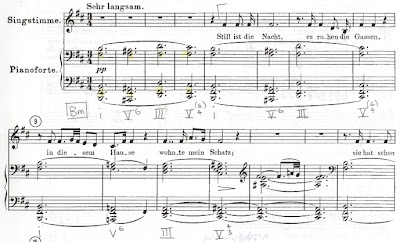
ii. Analyze the harmony for bars 1-11 and bs. 43-end.


Question 3: Schubert, “Der Doppelgänger” (Burkhart, 294-296; XCD 656)
i. Like “Eleanor Rigby”, this is also a depressing song, but far more powerful in its emotional portrayals. Can you identify two or three of the musical elements used in Schubert’s setting to achieve this? Consider the vocal line as well as the accompaniment.
In my very first listening of this piece, bearing in mind that this is going to be a depressing song, I immediately felt the starting chord very bare. This is because the first chord and also many of the subsequent chords have a missing third. But more importantly, on top of the missing thirds, the musical element used in portraying the ‘depressing’ mood is the open octaves used in the left hand of the accompaniment throughout the song (except for a few bars). Inside these octaves and also in the right-hand of the accompaniment is an F# inner pedal, forming an F# octave also almost throughout the whole song from b.1-46. [As a side note, this reminds me very much of Debussy’s ‘The Sunken Cathedral’ we did in class because of the bare octaves used with the E inner pedal found in b.7-13.]
Another feature is the modulation from B minor to D# minor through a series of chords which are rising chromatically below a stagnant melody. This is in b.43-47 where the “doppelganger” or “the double” is addressed directly for the first time (reading from the English translation). This feature of modulation creates a stronger atmosphere for this third stanza.
The last and most obvious element which contributes to the powerful portrayal of emotions is the wide range of dynamics used from ppp to fff. fff is used three times in this song. At b.31, the fff used coincides with F# which is the highest note so far. However, the real peak has yet to come. The actual climax of this song is at the second fff at b.41 with G which is one semitone above the previous. For the final fff, it attempts to peak again but not as much as the previous one. It then fades into a ppp as the song ends. This use of dynamics highlight the anguish and fear the writer must be feeling as described in the poem.
ii. Analyze the harmony for bars 1-11 and bs. 43-end.

Comments for analysis of b.43-46:As mentioned earlier, this is a series of chromatically ascending chords in the key of B minor eventually leading to D# minor. Initially I thought the chord in b.44 was simply vdim6/4. Later on, it was suggested that b.45 be analysed as a passing 6/4. This made me think further and analysed b.44 as the passing 6/4 instead, and b.45 to be not passing in function as it reminds me of the opening bars of I-V-III.


31 March 2007
Eleanor Rigby - Analysis
Eleanor Rigby - Analysis
This song is quite depressing. It talks about an unlamented death of an old and lonely spinster who used to clean up after joyful church weddings. This depressive mood is reflected in the music where descending lines are used throughout the song. It is in the key of Emin and also sound modal. Also, this whole song is written using only the harmony of C and Em chords (VI-I). Is there any term for this? or is there anything very significant about it?
In the Intro, the descending line A G F# E sung by the singer can be heard distinctly (b.1-2). This is repeated by the keyboard an octave lower as part of a compound melody (b.3-4). Also, there is a pedal point in b.1-2 and 5-6 below the descending line. This alternating between the voice and kbd of the descending melodic motif is repeated twice.
Moving on to the verse, most of it is made up of a decorated descending melodic line over a tonic pedal. D C# B A can be heard very distinctly (b.10-12 and 15-17). This line moves downwards in spirals gradually. The word-setting is also very apt because all the stressed syllables are held longer by the rhythmic displacement of the melody .
We've learnt about the '5-6' technique, and we've also learnt of other suspensions, but not '6-5'. In b.13 there is '6-5' suspension and also in b.12 which is separated by a long rest.
The chorus (b.19-29) can be looked at in 3 parts: the bass, 'tenor' and melody line.
The bass is a tonic pedal of Emin throughout. This gives a strong sense of the key in Emin even though the Dominant is not used once in this song. The 'tenor' line descends chromatically D-C#-C-B and adds to the harmony. As for the melody line, it has leaps of 8th (b.20) and 10th (b.24) upwards followed by a descending line. This style of the music climbing upwards quickly and gradually coming down is typical of this song as we have seen in the Verse section (b.10-11) and now in the chorus section (b.20-21 & b.24-25)
This song is quite depressing. It talks about an unlamented death of an old and lonely spinster who used to clean up after joyful church weddings. This depressive mood is reflected in the music where descending lines are used throughout the song. It is in the key of Emin and also sound modal. Also, this whole song is written using only the harmony of C and Em chords (VI-I). Is there any term for this? or is there anything very significant about it?
In the Intro, the descending line A G F# E sung by the singer can be heard distinctly (b.1-2). This is repeated by the keyboard an octave lower as part of a compound melody (b.3-4). Also, there is a pedal point in b.1-2 and 5-6 below the descending line. This alternating between the voice and kbd of the descending melodic motif is repeated twice.
Moving on to the verse, most of it is made up of a decorated descending melodic line over a tonic pedal. D C# B A can be heard very distinctly (b.10-12 and 15-17). This line moves downwards in spirals gradually. The word-setting is also very apt because all the stressed syllables are held longer by the rhythmic displacement of the melody .
We've learnt about the '5-6' technique, and we've also learnt of other suspensions, but not '6-5'. In b.13 there is '6-5' suspension and also in b.12 which is separated by a long rest.
The chorus (b.19-29) can be looked at in 3 parts: the bass, 'tenor' and melody line.
The bass is a tonic pedal of Emin throughout. This gives a strong sense of the key in Emin even though the Dominant is not used once in this song. The 'tenor' line descends chromatically D-C#-C-B and adds to the harmony. As for the melody line, it has leaps of 8th (b.20) and 10th (b.24) upwards followed by a descending line. This style of the music climbing upwards quickly and gradually coming down is typical of this song as we have seen in the Verse section (b.10-11) and now in the chorus section (b.20-21 & b.24-25)
Eleanor Rigby - Score
Eleanor Rigby - Score
I can’t think of a better way but to simply put all 3 pages of the score here instead of small specific sections like what I did earlier, cos a lot of my points are interlinked. Pardon me, cos its gonna be more difficult for you to refer to.. Perhaps you could just print them out! Thanks.
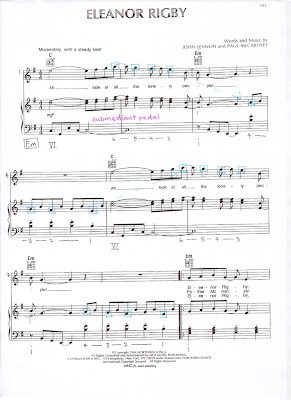


I can’t think of a better way but to simply put all 3 pages of the score here instead of small specific sections like what I did earlier, cos a lot of my points are interlinked. Pardon me, cos its gonna be more difficult for you to refer to.. Perhaps you could just print them out! Thanks.


Lady Madonna - Plagal Expansion
Lady Madonna - Plagal Expansion
After Dr Chong mentioned about Plagal Expansions in lesson last Tuesday, I couldn’t resist putting this song up here – Lady Madonna. So I’ll just have to put Eleanor Rigby on hold for the moment!

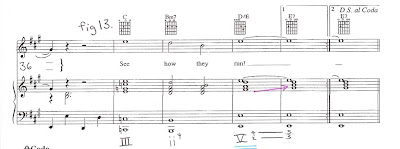
The Dominant of Amaj is finally used as seen in b.39-40 in fig.13 above. A suspension is used but it is not resolved the conventional way. It is a suspension followed by retardation (resolution upwards). But whatever the case, it definitely feels more comfortable and stable after being established in Amaj with the use of V after being tonally ambiguous throughout the whole song. This is further emphasized with a sudden increase in note values for these 4 bars. The whole song is slowed down and chord V becomes more prominent, confirming the tonal center.

After Dr Chong mentioned about Plagal Expansions in lesson last Tuesday, I couldn’t resist putting this song up here – Lady Madonna. So I’ll just have to put Eleanor Rigby on hold for the moment!

As you can see in fig. 11 above, the song starts with a plagal expansion of I-IV-I-IV-etc. and ends that phrase with VI-VII-VIII, completely avoiding out V. This deliberately creates tonal ambiguity.
Towards the middle of the song, it modulates to Cmaj where Cmaj is briefly established by an imperfect cadence. It then shifts back to plagal expansions in Amaj.

The Dominant of Amaj is finally used as seen in b.39-40 in fig.13 above. A suspension is used but it is not resolved the conventional way. It is a suspension followed by retardation (resolution upwards). But whatever the case, it definitely feels more comfortable and stable after being established in Amaj with the use of V after being tonally ambiguous throughout the whole song. This is further emphasized with a sudden increase in note values for these 4 bars. The whole song is slowed down and chord V becomes more prominent, confirming the tonal center.

At the end of the song, one would usually expect a resolution of sort in the home key. However this is not the case here. (fig. 12) Even though the chords provided says E7sus – A, it does not seem like a V7-I to me. I would think its iio7-I. Am I right by saying this?
Subscribe to:
Posts (Atom)
