Eleanor Rigby - Analysis
This song is quite depressing. It talks about an unlamented death of an old and lonely spinster who used to clean up after joyful church weddings. This depressive mood is reflected in the music where descending lines are used throughout the song. It is in the key of Emin and also sound modal. Also, this whole song is written using only the harmony of C and Em chords (VI-I). Is there any term for this? or is there anything very significant about it?
In the Intro, the descending line A G F# E sung by the singer can be heard distinctly (b.1-2). This is repeated by the keyboard an octave lower as part of a compound melody (b.3-4). Also, there is a pedal point in b.1-2 and 5-6 below the descending line. This alternating between the voice and kbd of the descending melodic motif is repeated twice.
Moving on to the verse, most of it is made up of a decorated descending melodic line over a tonic pedal. D C# B A can be heard very distinctly (b.10-12 and 15-17). This line moves downwards in spirals gradually. The word-setting is also very apt because all the stressed syllables are held longer by the rhythmic displacement of the melody .
We've learnt about the '5-6' technique, and we've also learnt of other suspensions, but not '6-5'. In b.13 there is '6-5' suspension and also in b.12 which is separated by a long rest.
The chorus (b.19-29) can be looked at in 3 parts: the bass, 'tenor' and melody line.
The bass is a tonic pedal of Emin throughout. This gives a strong sense of the key in Emin even though the Dominant is not used once in this song. The 'tenor' line descends chromatically D-C#-C-B and adds to the harmony. As for the melody line, it has leaps of 8th (b.20) and 10th (b.24) upwards followed by a descending line. This style of the music climbing upwards quickly and gradually coming down is typical of this song as we have seen in the Verse section (b.10-11) and now in the chorus section (b.20-21 & b.24-25)
31 March 2007


Eleanor Rigby - Score
Eleanor Rigby - Score
I can’t think of a better way but to simply put all 3 pages of the score here instead of small specific sections like what I did earlier, cos a lot of my points are interlinked. Pardon me, cos its gonna be more difficult for you to refer to.. Perhaps you could just print them out! Thanks.
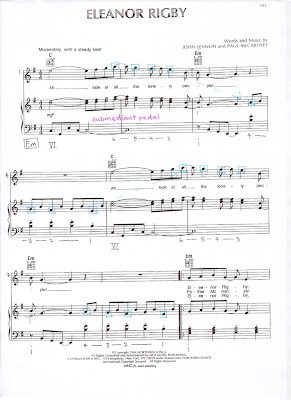


I can’t think of a better way but to simply put all 3 pages of the score here instead of small specific sections like what I did earlier, cos a lot of my points are interlinked. Pardon me, cos its gonna be more difficult for you to refer to.. Perhaps you could just print them out! Thanks.


Lady Madonna - Plagal Expansion
Lady Madonna - Plagal Expansion
After Dr Chong mentioned about Plagal Expansions in lesson last Tuesday, I couldn’t resist putting this song up here – Lady Madonna. So I’ll just have to put Eleanor Rigby on hold for the moment!

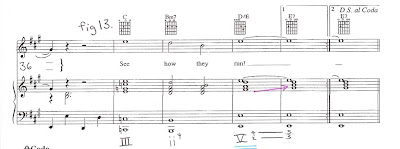
The Dominant of Amaj is finally used as seen in b.39-40 in fig.13 above. A suspension is used but it is not resolved the conventional way. It is a suspension followed by retardation (resolution upwards). But whatever the case, it definitely feels more comfortable and stable after being established in Amaj with the use of V after being tonally ambiguous throughout the whole song. This is further emphasized with a sudden increase in note values for these 4 bars. The whole song is slowed down and chord V becomes more prominent, confirming the tonal center.

After Dr Chong mentioned about Plagal Expansions in lesson last Tuesday, I couldn’t resist putting this song up here – Lady Madonna. So I’ll just have to put Eleanor Rigby on hold for the moment!

As you can see in fig. 11 above, the song starts with a plagal expansion of I-IV-I-IV-etc. and ends that phrase with VI-VII-VIII, completely avoiding out V. This deliberately creates tonal ambiguity.
Towards the middle of the song, it modulates to Cmaj where Cmaj is briefly established by an imperfect cadence. It then shifts back to plagal expansions in Amaj.

The Dominant of Amaj is finally used as seen in b.39-40 in fig.13 above. A suspension is used but it is not resolved the conventional way. It is a suspension followed by retardation (resolution upwards). But whatever the case, it definitely feels more comfortable and stable after being established in Amaj with the use of V after being tonally ambiguous throughout the whole song. This is further emphasized with a sudden increase in note values for these 4 bars. The whole song is slowed down and chord V becomes more prominent, confirming the tonal center.

At the end of the song, one would usually expect a resolution of sort in the home key. However this is not the case here. (fig. 12) Even though the chords provided says E7sus – A, it does not seem like a V7-I to me. I would think its iio7-I. Am I right by saying this?
Eleanor Rigby - Lyrics and Overall Form
Eleanor Rigby – Lyrics and Overall Form
Here are the Lyrics for Eleanor Rigby, the new song I'll be working on. It starts with a stand-alone introduction. This song is strophic with 3 verses having the same melody and harmony but different words set to it. And after each verse is the chorus.
{Intro}
Ah, look at all the lonely people
Ah, look at all the lonely people
{Verse 1}
Eleanor Rigby picks up the rice in the church where a wedding has been
Lives in a dream
Waits at the window, wearing the face that she keeps in a jar by the door
Who is it for?
{Chorus}
All the lonely people
Where do they all come from?
All the lonely people
Where do they all belong?
{Verse 2}
Father McKenzie writing the words of a sermon that no one will hear
No one comes near.
Look at him working.
Darning his socks in the night when there's nobody there
What does he care?
{Chorus}
{Verse 3}
Eleanor Rigby died in the church and was buried along with her name
Nobody came
Father McKenzie wiping the dirt from his hands as he walks from the grave No one was saved
{Chorus}
Here are the Lyrics for Eleanor Rigby, the new song I'll be working on. It starts with a stand-alone introduction. This song is strophic with 3 verses having the same melody and harmony but different words set to it. And after each verse is the chorus.
{Intro}
Ah, look at all the lonely people
Ah, look at all the lonely people
{Verse 1}
Eleanor Rigby picks up the rice in the church where a wedding has been
Lives in a dream
Waits at the window, wearing the face that she keeps in a jar by the door
Who is it for?
{Chorus}
All the lonely people
Where do they all come from?
All the lonely people
Where do they all belong?
{Verse 2}
Father McKenzie writing the words of a sermon that no one will hear
No one comes near.
Look at him working.
Darning his socks in the night when there's nobody there
What does he care?
{Chorus}
{Verse 3}
Eleanor Rigby died in the church and was buried along with her name
Nobody came
Father McKenzie wiping the dirt from his hands as he walks from the grave No one was saved
{Chorus}
22 February 2007
Lucy In The Sky With Diamonds & Beatles Background
Lucy in the Sky with Diamonds & Beatles Background
John Lennon got his primary inspiration for this song from his son, Julian Lennon. Julian had a painting of his classmate Lucy at his nursery and described it as "Lucy in the Sky with Diamonds". This theme stuck in John's mind and he developed the music from there, also adding in more dream-like ideas influenced from his love for surrealism. (With reference to 'A Hard Day's Write' by Steve Turner)
It is also interesting that there were persistant rumours of "Lucy in the Sky with Diamonds" sending a cryptic message about LSD. Despite John's denial, this accusation was quite believable as the Beatles were into drugs and LSD was the latest fad then. Ever since they started tripping out on drugs, it was very evident the type of drug they took affected the kind of music they produced. They tripped from alcohol in 1964 to marijuana in 1966 to acid (LSD) and finally heroine in the last few years.
This text I came across (Rock and Roll: an introduction by Michael Campbell) draws specific relations between this song and the drug very aptly. "The verse creates a dreamy state. The lyric contains numerous psychedelic images (e.g., "marmalade skies") and the music floats along in waltz time. It gives the impression of a person in the middle of an acid trip. By contrast, the chorus is straight-ahead rock and roll, which conveys a sense of normalcy. The repetition of the title phrase suggests a second persona in the song: someone observing the person who's tripping in the verse."
Aha! This explains the surprising shift to the tonal functional harmony of T PD D T in the refrain section from the non-standard function verses! (refer to section on harmonic and functional analysis) Way cool.
John Lennon got his primary inspiration for this song from his son, Julian Lennon. Julian had a painting of his classmate Lucy at his nursery and described it as "Lucy in the Sky with Diamonds". This theme stuck in John's mind and he developed the music from there, also adding in more dream-like ideas influenced from his love for surrealism. (With reference to 'A Hard Day's Write' by Steve Turner)
It is also interesting that there were persistant rumours of "Lucy in the Sky with Diamonds" sending a cryptic message about LSD. Despite John's denial, this accusation was quite believable as the Beatles were into drugs and LSD was the latest fad then. Ever since they started tripping out on drugs, it was very evident the type of drug they took affected the kind of music they produced. They tripped from alcohol in 1964 to marijuana in 1966 to acid (LSD) and finally heroine in the last few years.
This text I came across (Rock and Roll: an introduction by Michael Campbell) draws specific relations between this song and the drug very aptly. "The verse creates a dreamy state. The lyric contains numerous psychedelic images (e.g., "marmalade skies") and the music floats along in waltz time. It gives the impression of a person in the middle of an acid trip. By contrast, the chorus is straight-ahead rock and roll, which conveys a sense of normalcy. The repetition of the title phrase suggests a second persona in the song: someone observing the person who's tripping in the verse."
Aha! This explains the surprising shift to the tonal functional harmony of T PD D T in the refrain section from the non-standard function verses! (refer to section on harmonic and functional analysis) Way cool.
21 February 2007
Lucy In The Sky With Diamonds - Other Features
Lucy In The Sky With Diamonds - Other Features
 The intro to this song (fig.10) is a short 4-bar melody. Despite it being very angular, it manages to blend in well with Verse 1 which follows immediately after. The reason being, it is actually a compound melody. After the intro, this descending line of A G F# F E then shifts to the bass and recurs throughout the first section of Verses 1, 2 and 3.
Lucy In The Sky With Diamonds - Modulations
Lucy In The Sky With Diamonds - Modulations
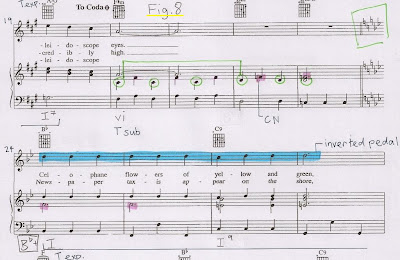 A Common Note F is used across b.22-26 (fig.8) to ensure a smooth transition from Amaj to Bbmaj. Another feature which contributes to the modulation is the C# note rising a semitone to D as the key rises a semitone as well. It serves as a form of preparation so the listener can expect this change.
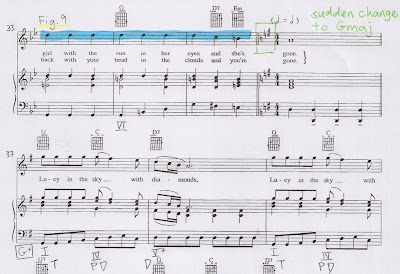 On the other hand, the second modulation at the refrain (fig.9) does not have any form of preparation like the first modulation. It shifts from Bbmaj to an unrelated key of Gmaj. The change sounds drastic and must have been done deliberately.
 A Common Note F is used across b.22-26 (fig.8) to ensure a smooth transition from Amaj to Bbmaj. Another feature which contributes to the modulation is the C# note rising a semitone to D as the key rises a semitone as well. It serves as a form of preparation so the listener can expect this change.
 On the other hand, the second modulation at the refrain (fig.9) does not have any form of preparation like the first modulation. It shifts from Bbmaj to an unrelated key of Gmaj. The change sounds drastic and must have been done deliberately.
Lucy In The Sky With Diamonds - Harmonic and Functional Analysis
Lucy In The Sky With Diamonds - Harmonic and Functional Analysis

-This song ends in an interesting way. (fig. 7) Initially I simply thought it ends curiously on a PD. However, I realised it actually ends on T of Amaj, which is the first chord of this piece. There is no resolution here. This is also a common practice in pop music.


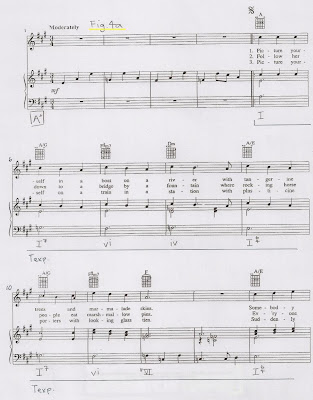
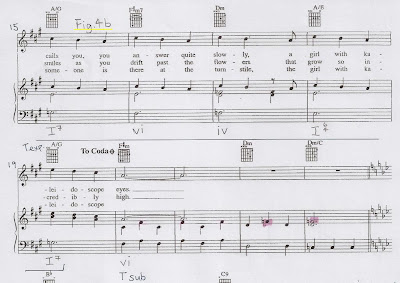
-The entire first section of verse 1 from b.5-19 (fig.4a&4b) can be seen as a T Exp. It then ends with a T Sub in b.20.

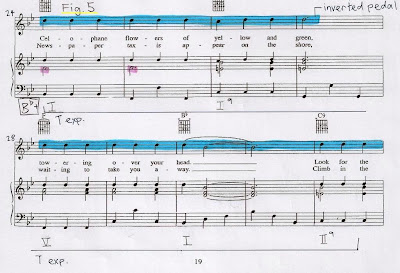
-In the Bbmaj section from from b.24-35 (fig.5), the repeating note D in the melody line forms an inverted pedal. This section can also be taken as a T exp.

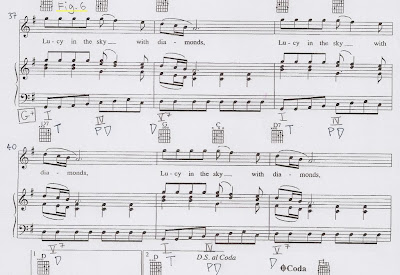
-The refrain section (fig.6) comes as a surprise as it sounds distinct from the rest of the song. It is completely tonal and makes use of only the primary chords I, IV, V. This is to emphasize the theme which is 'Lucy in the Sky with Diamonds'.

-This song ends in an interesting way. (fig. 7) Initially I simply thought it ends curiously on a PD. However, I realised it actually ends on T of Amaj, which is the first chord of this piece. There is no resolution here. This is also a common practice in pop music.
17 February 2007
Lucy In The Sky With Diamonds - Lyrics and Overall Structure
Lucy In The Sky With Diamonds - Lyrics and Overall Structure
The structure of this song is in a simple and straightforward verse-refrain form. However, the only anomaly would be that verse 3 is half the length of what it should be like in verses 1 and 2. It goes straight into the refrain and makes up for the loss of half the verse by repeating the refrain.
{VERSE 1}
Picture yourself in a boat on a river,
With tangerine trees and marmalade skies
Somebody calls you, you answer quite slowly,
A girl with kaleidoscope eyes.
Cellophane flowers of yellow and green,
Towering over your head.
Look for the girl with the sun in her eyes,
And she's gone.
{REFRAIN}
Lucy in the sky with diamonds(diamonds).
Lucy in the sky with diamonds(diamonds).
Lucy in the sky with diamonds(diamonds).
Ah... Ah...
{VERSE 2}
Follow her down to a bridge by a fountain
Where rocking horse people eat marshmallow pies,
Everyone smiles as you drift past the flowers,
That grow so incredibly high.
Newspaper taxis appear on the shore,
Waiting to take you away.
Climb in the back with your head in the clouds,
And you're gone.
{REFRAIN}
{VERSE 3}
Picture yourself on a train in a station,
With plasticine porters with looking glass ties,
Suddenly someone is there at the turnstile,
The girl with kaleidoscope eyes.
{REFRAIN REPEATED}
The structure of this song is in a simple and straightforward verse-refrain form. However, the only anomaly would be that verse 3 is half the length of what it should be like in verses 1 and 2. It goes straight into the refrain and makes up for the loss of half the verse by repeating the refrain.
{VERSE 1}
Picture yourself in a boat on a river,
With tangerine trees and marmalade skies
Somebody calls you, you answer quite slowly,
A girl with kaleidoscope eyes.
Cellophane flowers of yellow and green,
Towering over your head.
Look for the girl with the sun in her eyes,
And she's gone.
{REFRAIN}
Lucy in the sky with diamonds(diamonds).
Lucy in the sky with diamonds(diamonds).
Lucy in the sky with diamonds(diamonds).
Ah... Ah...
{VERSE 2}
Follow her down to a bridge by a fountain
Where rocking horse people eat marshmallow pies,
Everyone smiles as you drift past the flowers,
That grow so incredibly high.
Newspaper taxis appear on the shore,
Waiting to take you away.
Climb in the back with your head in the clouds,
And you're gone.
{REFRAIN}
{VERSE 3}
Picture yourself on a train in a station,
With plasticine porters with looking glass ties,
Suddenly someone is there at the turnstile,
The girl with kaleidoscope eyes.
{REFRAIN REPEATED}
Lucy In The Sky With Diamonds
Lucy In The Sky With Diamonds
I've selected Lucy In The Sky With Diamonds as my first piece to work on. It's taken from the album Sgt. Pepper's Lonely Hearts Club Band, and this album has been hailed for its lyrical and musical brilliance. The Beatles made waves throughout the world again when this album was released in June 1967 as this kind of music they created was considered unconventional then.
The history aside, here are some things I’ll be looking at:
- Harmonic and Functional (H&F) analysis of selected portions
- Overall Structure
- Modulations
The Beatles
The Beatles!
 As you can see, I'll be working on The Beatles!! =) Been listening to Beatles for the past few weeks and found that their songs do have rather unique harmonies. However they mostly sound somewhat similar to me and gets less interesting after awhile. Nevertheless, they were able to capture the hearts and ears of people all over the world with their music throughout the 1960s. Which aspect of their music led to their resounding success? We'll find out.
18 January 2007
ethnic or pop?

Helloo!! Glad to be back here again. =P School has resumed for 2 weeks already and once again I embark on my mini music analysis project.
Well, this time I'll be looking into either ethnic music or perhaps popular music.. Hmm I'll decide soon. So, look out!!
14 November 2006
Analysis 2
Analysis 2 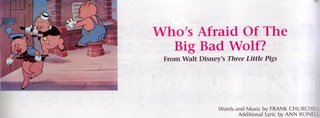
Since time immemorial, songs from Disney cartoons have been my all-time favourite. They are always easily recognisable with their distinct and special tone colour which sounds almost magical, and at the same time the melodies are very simple, memorable and easy to sing. This fascinating "Disney sound" prompted me to take a closer look into the musical details of Disney songs. Hence, I have selected Walt Disney’s very first sing-a-long classic "Who's Afraid of the Big Bad Wolf" for analysis.
Background
This song is taken from Walt Disney's Three Little Pigs which was released in 1933. Just like most Disney cartoons, they have 3 different dimensions, viz. Words, Music, and Animation/Story. They are arranged in increasing order of importance. This is illustrated in this case where the story of the Three Little Pigs was written first, then Frank Churchill wrote the music in 1930, and the words were added much later by Ann Ronell. This is unlike most other films and musicals in those days where the music dimension took precedence.
Form
The structure of this song is generally A B B' A. Although there are no repeats for A, it is still in the simple ternary form. The reprise is an exact repeat of A as indicated by the Da Capo direction at the end of B' with no changes in key, texture or melody. The middle section takes on a different theme and key from A, like all simple ternary forms where the middle section does not develop the ideas in A, but has a totally different scheme to show contrast.
Harmony and Tonality
This song starts in Gmaj and modulates to its dominant Dmaj in the middle section.
Fig 3a
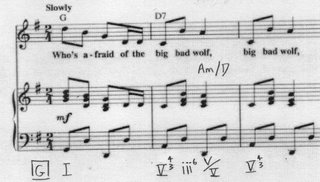
In bar 2, instead of a simple D7(V7) chord as suggested by the writer, more than that is going on in the harmony (see Fig 3a above). A slight touch of minor chord iii is used followed by tonicization of V. This progression is one example which accentuates the fairytale-like "Disney sound" which I mentioned earlier.
Fig. 3b
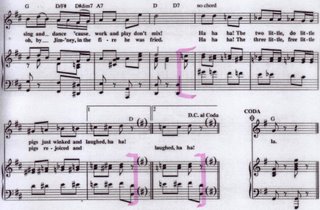
For the transition of B to B' and B' to the reprise, Churchill makes use of a short passage of descending and ascending chromatic harmony (see Fig. 3b above)
Melody and Phrasing
Fig. 3c
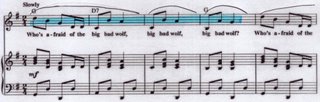
Fig. 3d
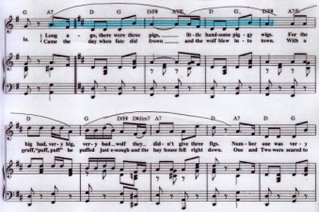
There are two main melodic ideas in this song. These can be seen in blue in Fig. 3c and 3d. The melody is built mainly on repetitions. The phrasing of the melody in this piece is quite interesting.
As seen in Fig. 3c, it has a 'l' 's' 's' sentence structure instead of the 's' 's' 'l' structure we commonly see. It seems as if this is done to accommodate the three-word motif "big bad wolf", but we have to remember that the music was written first before the words.
In the second sentence of Fig. 3d, we see an asymmetrical sentence of approximately 1 bar followed by 3 bars. Aurally we would expect it to be 1+1+2 but it turned out 1+3.
Accompaniment
The LH of the accompaniment in sections A and B differs. In A, the LH uses the alberti bass figuration for the bass (see Fig. 3c). Whereas for B, only 5ths and 8ves of the chord are played on each downbeat (see Fig. 3d). This further shows the contrast between A and B.
Since time immemorial, songs from Disney cartoons have been my all-time favourite. They are always easily recognisable with their distinct and special tone colour which sounds almost magical, and at the same time the melodies are very simple, memorable and easy to sing. This fascinating "Disney sound" prompted me to take a closer look into the musical details of Disney songs. Hence, I have selected Walt Disney’s very first sing-a-long classic "Who's Afraid of the Big Bad Wolf" for analysis.
Background
This song is taken from Walt Disney's Three Little Pigs which was released in 1933. Just like most Disney cartoons, they have 3 different dimensions, viz. Words, Music, and Animation/Story. They are arranged in increasing order of importance. This is illustrated in this case where the story of the Three Little Pigs was written first, then Frank Churchill wrote the music in 1930, and the words were added much later by Ann Ronell. This is unlike most other films and musicals in those days where the music dimension took precedence.
Form
The structure of this song is generally A B B' A. Although there are no repeats for A, it is still in the simple ternary form. The reprise is an exact repeat of A as indicated by the Da Capo direction at the end of B' with no changes in key, texture or melody. The middle section takes on a different theme and key from A, like all simple ternary forms where the middle section does not develop the ideas in A, but has a totally different scheme to show contrast.
Harmony and Tonality
This song starts in Gmaj and modulates to its dominant Dmaj in the middle section.
Fig 3a

In bar 2, instead of a simple D7(V7) chord as suggested by the writer, more than that is going on in the harmony (see Fig 3a above). A slight touch of minor chord iii is used followed by tonicization of V. This progression is one example which accentuates the fairytale-like "Disney sound" which I mentioned earlier.
Fig. 3b

For the transition of B to B' and B' to the reprise, Churchill makes use of a short passage of descending and ascending chromatic harmony (see Fig. 3b above)
Melody and Phrasing
Fig. 3c
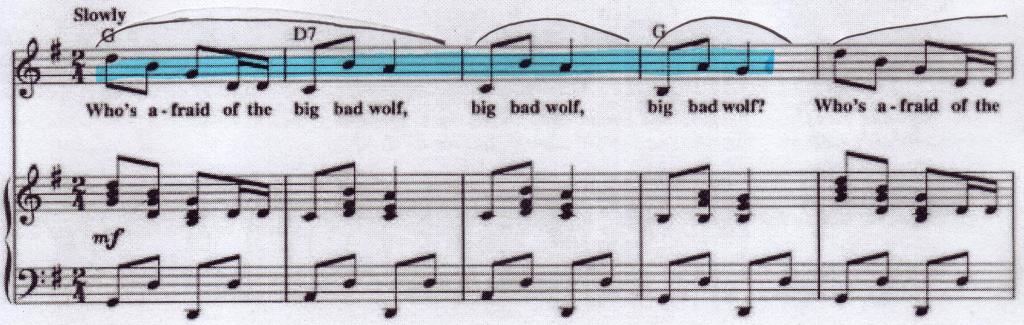
Fig. 3d

There are two main melodic ideas in this song. These can be seen in blue in Fig. 3c and 3d. The melody is built mainly on repetitions. The phrasing of the melody in this piece is quite interesting.
As seen in Fig. 3c, it has a 'l' 's' 's' sentence structure instead of the 's' 's' 'l' structure we commonly see. It seems as if this is done to accommodate the three-word motif "big bad wolf", but we have to remember that the music was written first before the words.
In the second sentence of Fig. 3d, we see an asymmetrical sentence of approximately 1 bar followed by 3 bars. Aurally we would expect it to be 1+1+2 but it turned out 1+3.
Accompaniment
The LH of the accompaniment in sections A and B differs. In A, the LH uses the alberti bass figuration for the bass (see Fig. 3c). Whereas for B, only 5ths and 8ves of the chord are played on each downbeat (see Fig. 3d). This further shows the contrast between A and B.
15 October 2006
Re-look at I Dreamed a Dream
RE-LOOK AT I Dreamed a Dream
Fig 2a
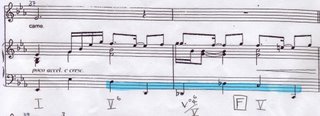
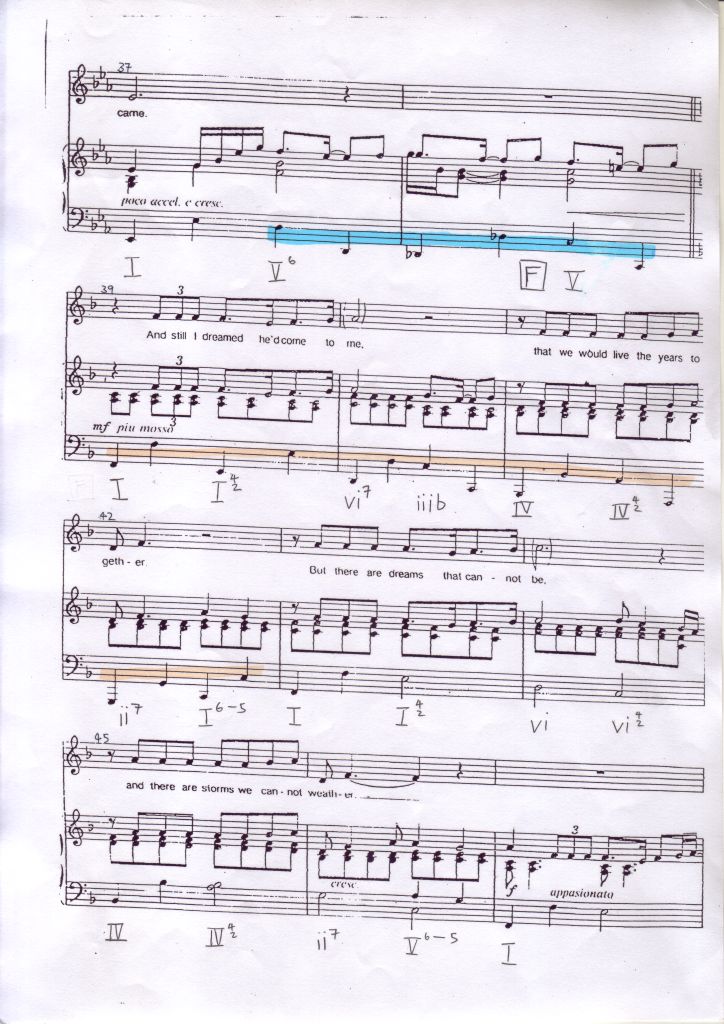
As said earlier, the descending chromatic progression in bars 37-38 is used as a transition from EbMajor to FMajor. The style of this chromatic descent is similar to the ground bass progression, except that octave leaps are used to add interest. A secondary dominant chord is also used to ensure the smooth transition, and it is a lament bass. (refer fig.2a)
Fig 2b
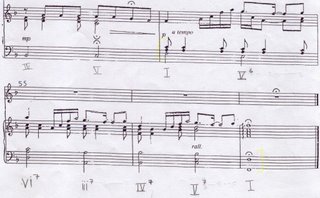
In the final bars, the descending base line takes up more of a chordal structure rather than just a single descending line as seen throughout the piece. It is more stable and allows the cadence at the end to sound out more. This gives a strong sense of closure. (refer fig.2b)
Fig 2c
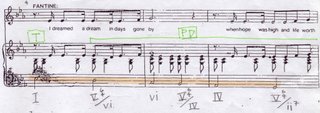
Here's the analysis of the opening phrase using secondary dominants. Can it be analysed this way too even though they are passing in function? (refer fig.2c)
Fig 2d
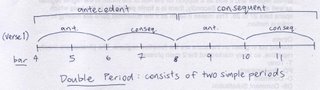
About the phrase structure, this piece is made up of symmetrical and double periods. (refer fig 2d)
Fig 2a
As said earlier, the descending chromatic progression in bars 37-38 is used as a transition from EbMajor to FMajor. The style of this chromatic descent is similar to the ground bass progression, except that octave leaps are used to add interest. A secondary dominant chord is also used to ensure the smooth transition, and it is a lament bass. (refer fig.2a)
Fig 2b
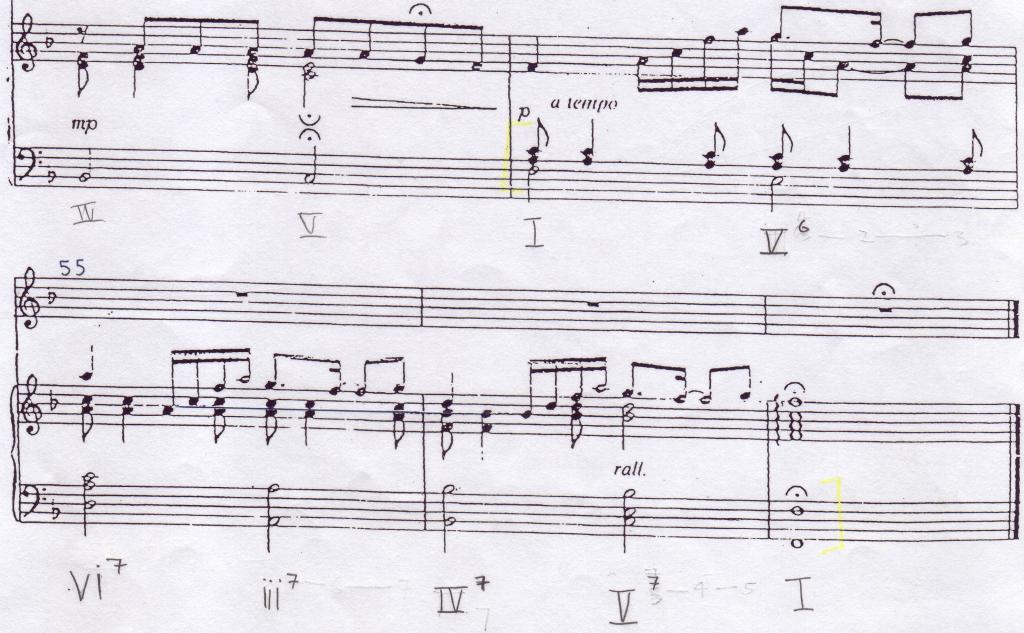
In the final bars, the descending base line takes up more of a chordal structure rather than just a single descending line as seen throughout the piece. It is more stable and allows the cadence at the end to sound out more. This gives a strong sense of closure. (refer fig.2b)
Fig 2c
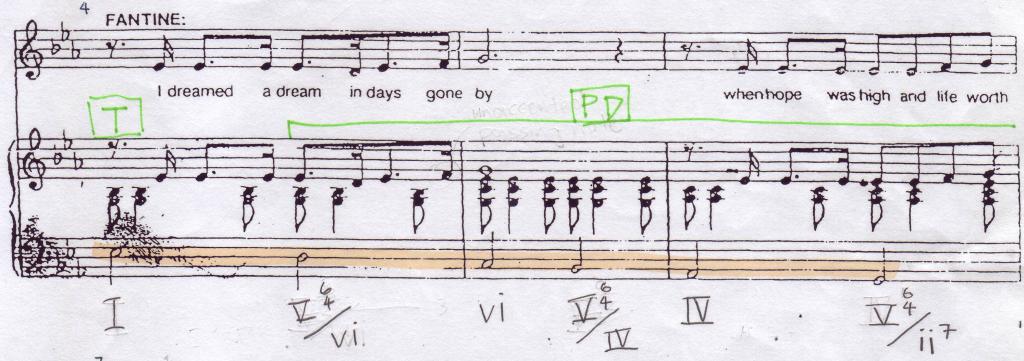
Here's the analysis of the opening phrase using secondary dominants. Can it be analysed this way too even though they are passing in function? (refer fig.2c)
Fig 2d
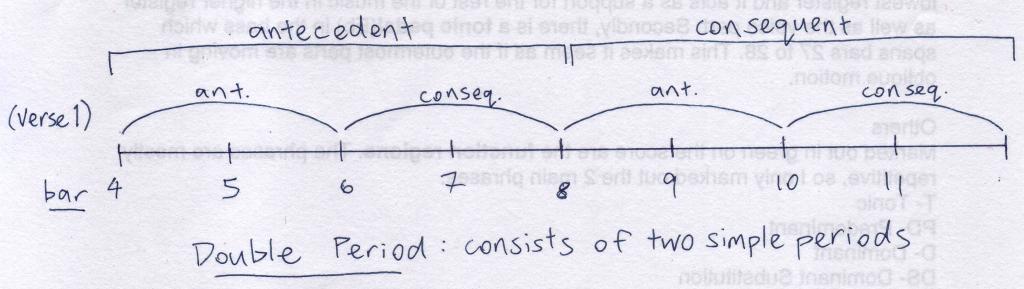
About the phrase structure, this piece is made up of symmetrical and double periods. (refer fig 2d)
05 September 2006
Analysis 1(Score+Harmonic analysis)

.jpg)
Subscribe to:
Posts (Atom)


